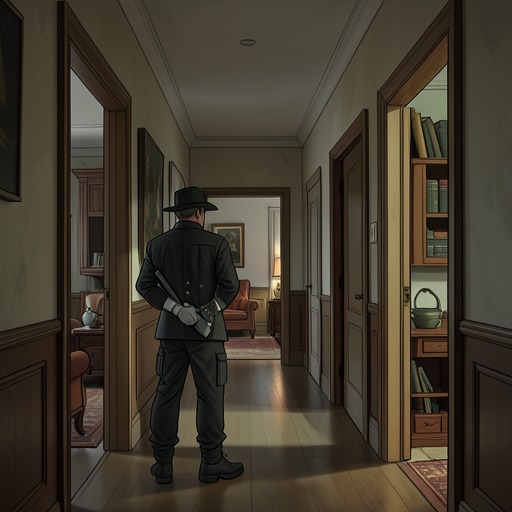
Opening of Rostov's Secret Study in the Metropol Attic
A Gentleman in MoscowThe opening of Count Alexander Ilyich Rostov’s secret study transforms an overlooked space inside The Metropol into a private refuge. The discovery follows a visit to Suite 317, where the traces of an ordinary afternoon at liberty sharpen his awareness of confinement. By forcing a passage through the back of his closet, furnishing the room he finds, and closing its hallway entrance with nails, he makes a space that is physically no larger than his bedroom yet feels expansive because it belongs to his own intention.
From Suite 317 to the closet wall
Later that night, alone on his bed, the Count revisits the scene in his old suite. The family clock is still ticking by the door, and the architecture and view are impressive, but it is the tea service beside a folded paper that remains with him. From these modest objects he reconstructs the absent resident’s afternoon: returning from an outing at four, hanging up a jacket, calling for tea and an afternoon edition, and settling on the couch before dressing for dinner. What he has witnessed, he realizes, is more than tea; it is a moment in the daily life of a gentleman at liberty.
The contrast makes his own hundred-square-foot room seem smaller than before. The bed crowds the coffee table, the table crowds the high-back chair, and the chair must be moved whenever the closet is opened. There is no room for the unhurried, civilized interval he has just imagined. Yet the Count’s attention shifts from the room’s limits to the possibility that its boundaries conceal another space. The thought that there are rooms behind rooms and doors behind doors becomes not merely a reflection on the hotel but a practical suggestion.
Breaking through and finding another room
The Count rises and examines the closet’s elegant molding, wondering whether the structure might occupy an older doorway. He moves his clothes aside and taps the back wall. Its thin, flexible sound encourages him to test it more forcefully. After removing all his jackets, he braces himself against the jambs and kicks until the barrier cracks and splinters. He pulls the broken planks into his room and slips through the opening.
Beyond the breach is a dark, narrow space smelling of dry cedar, apparently the inside of the neighboring closet. The Count turns its knob and enters a room that mirrors his own in shape and size. Five unused bedframes have been stored there; two have fallen against the wall and pinned the hallway door shut. He shifts them, opens the door, removes the stored objects, and begins to refurnish the newly accessible room. The discovery is both architectural and practical: a hidden passage through the closet has led to a whole adjoining room, while the fallen frames explain why its ordinary entrance was inaccessible.
Furnishing a room of his own
He first brings the two high-back chairs together with his grandmother’s coffee table. Then he makes three separate trips down the belfry stairs to the basement cabinet of curiosities for a rug, a standing lamp, and a small bookcase. On one final trip he carries up ten weighty novels that had been abandoned there. The furnishings are not gathered as a random store of necessities: the chairs and table establish a place to sit, the lamp and rug make it habitable, and the bookcase and books give it the character of a study.
To secure the room’s privacy, the Count borrows the roofer’s hammer and five nails. The hammer recalls his boyhood at Idlehour Estate, where he helped the old caretaker repair fencing in early spring. His first stroke now lands on his thumb; the next glances off the nail. By the third blow he finds his rhythm again. Within half an hour, he has driven four nails through the door’s edge into its frame, so that the study can thereafter be entered only through the sleeves of his jackets. He reserves the fifth nail for the wall above the bookcase, where it will hold Helena Rostov’s portrait. The improvised barrier both conceals the new room and turns the closet into its sole passage.
A secret space and its meaning
When the work is done, the Count sits in one of the high-back chairs and feels an unexpectedly deep sense of bliss. His bedroom and study have identical dimensions, but their effects on him could hardly be more different. The bedroom, with its bed, bureau, and desk, answers practical necessities. The study gathers objects connected with memory and inward life: his grandmother’s table, the books, The Ambassador, and Helena Rostov’s portrait. Its character comes not only from what it contains but from how it came to exist.
The room’s secrecy changes the meaning of its smallness. The bedroom belongs to an arrangement imposed by others; the study has been made through the Count’s own ingenuity, labor, and choices. Its dimensions remain unchanged, yet it can seem as vast as he wishes because its existence is not governed by the same authority as his assigned quarters. The event thus answers confinement with a modest act of spatial invention: rather than escaping The Metropol, he discovers how to enlarge his life within it.
He takes the largest of the ten recovered volumes, settles back with one foot on the coffee table, and balances the chair on its hind legs. Opening the book, he reads, “All happy families are alike; each unhappy family is unhappy in its own way.” The study’s first completed moment is therefore not a further act of construction but a return to reading. After the strain of breaking through, carrying furniture, and hammering nails, the Count occupies the room as a reader, in a space arranged to serve the spirit as well as the body.